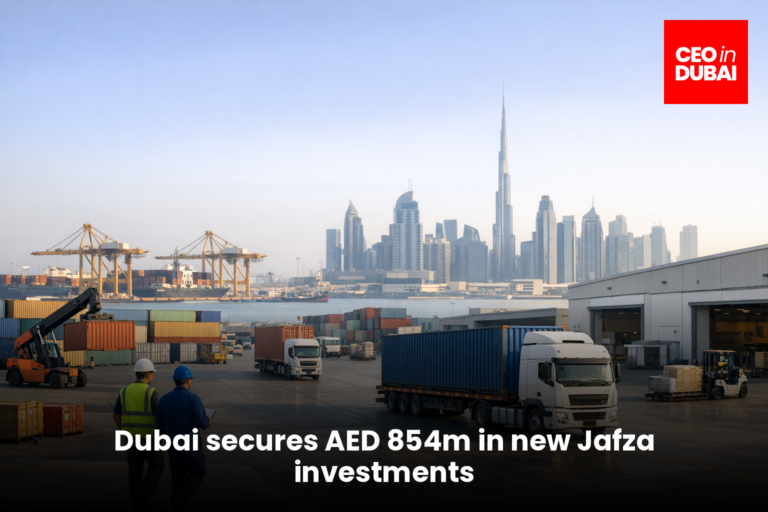
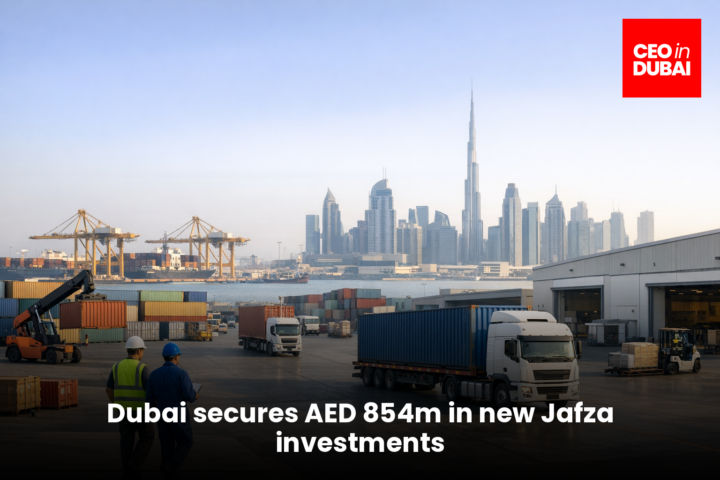
DP World’s Jebel Ali Free Zone secured AED 854 million, or $232.5 million, in new investments in the first four months of 2026, reinforcing Dubai’s position as a trade and industrial base for companies serving the Middle East, Africa and South Asia.
The pace accelerated sharply as the period progressed. More than 43% of the total commitments were signed in March and April, a sign that companies are not only exploring Dubai but committing capital to long-term operations inside one of the emirate’s most important commercial zones.
The commitments behind the headline
The AED 854 million figure covers new investments secured by Jafza between January and April 2026. For DP World, the number matters because it reflects tenant decisions across sectors that depend on infrastructure, customs access, warehousing, manufacturing space and proximity to shipping routes.
Jafza is not a small, emerging district trying to prove its case. It is home to approximately 12,000 businesses and sits at the centre of Dubai’s trade and industrial growth. New capital flowing into a mature zone of that scale suggests companies are choosing to deepen their physical presence rather than limit Dubai to a representative office or sales outpost.
More than 43% of Jafza’s AED 854 million in new investment commitments during the first four months of 2026 were signed in March and April.
That late-period momentum is important for founders, operators and family-owned businesses assessing the market. Investment decisions in manufacturing, healthcare, logistics, automotive handling and heavy equipment usually require more than optimism. They involve facilities, inventory, staff, compliance and multi-year planning. The capital committed to Jafza points to business models being built for durability.
Where the money is going
The new investments span several practical sectors. Manufacturing companies in steel, food products and furniture are expanding production capacities. These are not abstract digital plays. They rely on supply chains, raw materials, storage, labour planning and transport links, which makes location critical.
Healthcare businesses are establishing long-term operations in Dubai, while logistics providers are enhancing warehousing operations. Automotive operators are investing in vehicle handling facilities, and heavy equipment traders are positioning themselves to serve construction and industrial clients. The sector mix gives the latest Jafza commitments a grounded profile: production, storage, movement, handling and distribution.
Food and healthcare stand out because they sit close to resilience planning. The research brief points to essential sectors as part of the investment story, and that matters for companies building regional capacity. Businesses that handle food products or healthcare operations need continuity, access and predictable infrastructure. Dubai’s offer, through Jafza, is a platform where those requirements can be tied to trade routes and warehousing networks.
Why Jafza keeps winning boardroom attention
Jafza’s strongest advantage is geographic and operational. The free zone is adjacent to Jebel Ali Port and near Al Maktoum International Airport, giving companies integrated sea, air and land connectivity. For businesses moving goods across the Middle East, Africa and South Asia, that combination reduces friction in planning and execution.
The location also gives founders and operators more than a warehouse address. A manufacturer can think about inbound materials and outbound finished products. A logistics provider can design storage around port access. An automotive operator can invest in vehicle handling with regional distribution in mind. A heavy equipment trader can serve construction and industrial clients from a base linked to multiple transport modes.
This is why the latest investment figure carries weight beyond the headline number. Dubai’s appeal as a trade and industrial hub depends on companies putting real operations on the ground. Jafza’s community of around 12,000 businesses creates an ecosystem where suppliers, traders, manufacturers and service providers sit near the infrastructure they use.
The DP World view on long-term capital
Abdulla Al Hashmi, Global Chief Operating Officer of Parks and Economic Zones at DP World, has highlighted a shift towards long-term investments, with major tenants anchoring their regional and global operations in Dubai for the coming decades. That framing is central to understanding the latest commitments.
For DP World, Jafza is not only a property or licensing play. It is part of a wider trade ecosystem built around port access, industrial capacity and movement of goods. When tenants commit to production capacity, healthcare operations, warehousing, vehicle handling or heavy equipment trading, they plug into that ecosystem in ways that are difficult to reverse quickly.
The founder and business angle is clear. Companies choosing Jafza are making decisions about where to base future growth, how to manage supply chains and how to serve regional customers. The investments show that Dubai is still attracting businesses prepared to put capital into physical infrastructure, even as regional disruptions test confidence across markets.
What this means for Dubai’s industrial next phase
The AED 854 million secured in the first four months of 2026 strengthens Dubai’s case as a place where trade, industry and logistics converge. The investments are spread across sectors that support everyday economic activity: food, healthcare, warehousing, automotive handling, furniture, steel and heavy equipment.
For investors, the signal is not only that money is entering Jafza. It is that different types of businesses are using the zone to solve operational problems. Manufacturers need capacity. Healthcare companies need durable bases. Logistics firms need warehousing. Automotive operators need handling facilities. Heavy equipment traders need access to construction and industrial clients. Jafza’s value lies in connecting those needs to a transport and trade platform.
Dubai will now be judged by how effectively these commitments turn into active facilities, expanded capacity and deeper trade flows. With March and April delivering more than 43% of the period’s investment commitments, the next test is whether that momentum continues into the rest of 2026.