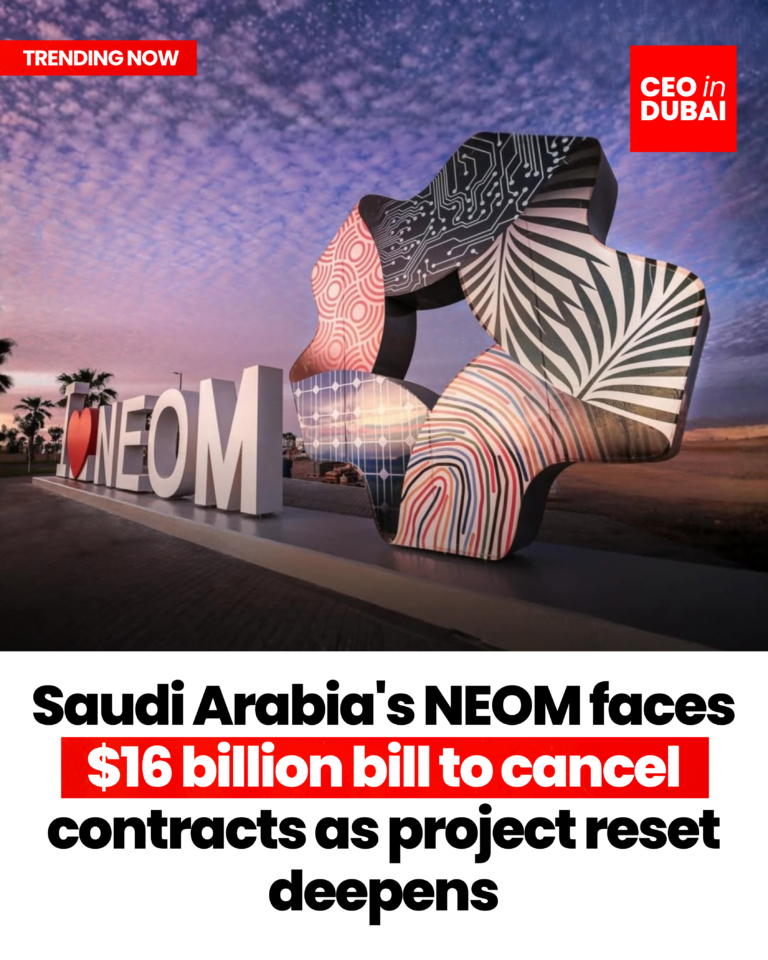
Saudi Arabia’s NEOM, once introduced to the world as a symbol of boundless ambition and futuristic urban transformation, is now entering one of the most important phases in its development journey: reassessment.
According to recent reports, the kingdom is expected to allocate approximately 60 billion riyals, around $16 billion, between 2026 and 2030 toward cancelling long-term contracts linked to parts of NEOM. The reported penalty payments could exceed planned construction spending for the project during the same period, highlighting the high financial cost of slowing down a development of such unprecedented scale.
NEOM was originally positioned as a transformative pillar of Saudi Arabia’s Vision 2030, designed to diversify the kingdom’s economy, attract global investment, and create a new model for urban living. Located in northwest Saudi Arabia, the project was envisioned as a vast futuristic region combining advanced technology, sustainability, tourism, logistics, clean energy, and new forms of city life.
At the center of global attention was The Line, a planned 170-kilometer linear city promoted as a radical alternative to traditional urban development. Alongside it, NEOM included major destinations such as Oxagon, Trojena, Sindalah, and other luxury, industrial, and innovation-driven zones. Over time, however, the size and cost of these ambitions have come under increasing scrutiny.
The latest reassessment reflects a broader shift inside Saudi Arabia’s national development strategy. After years of rapid expansion across multiple giga-projects, the kingdom appears to be prioritizing initiatives that can deliver clearer returns, stronger infrastructure value, and strategic relevance to upcoming national milestones.
Key areas now drawing greater attention include defence and national security, artificial intelligence, logistics, advanced infrastructure, Expo 2030 in Riyadh, and preparations for the FIFA World Cup 2034. These priorities are not a rejection of Vision 2030, but rather a sign that the kingdom is refining how it allocates resources in a changing economic and geopolitical environment.
The appointment of Eng. Aiman Al-Mudaifer as NEOM’s Managing Director and CEO marks a significant leadership moment in this transition. Since taking on the role, Al-Mudaifer has been associated with efforts to improve operational efficiency, maintain continuity, and guide NEOM into a more disciplined phase of delivery. Reports suggest that the strategic review under his leadership has included workforce restructuring, corporate adjustments, and a careful reassessment of project timelines and development priorities.
This shift also comes after concerns around budget pressures and lower-than-anticipated levels of foreign direct investment. Mega-projects of NEOM’s scale depend not only on government funding, but also on private capital, international confidence, and long-term commercial viability. When those conditions become more complex, even the most ambitious national projects must adapt.
For Saudi Arabia, the challenge is not simply whether NEOM can be built. The deeper question is how much of it should be built now, which parts should be prioritized, and how the project can remain relevant without becoming financially unsustainable.
Oxagon, NEOM’s industrial and logistics hub, appears to remain strategically important due to its connection to ports, manufacturing, data infrastructure, and supply chains. Other elements, particularly those with higher costs or less immediate economic return, may face delays, redesigns, or reduced scope.
The reported cancellation costs also reveal an important reality about mega-project economics. Halting or resizing a project does not mean spending stops immediately. Long-term agreements, contractor obligations, penalty clauses, and partially completed works can create major financial liabilities. In NEOM’s case, the cost of changing direction may itself become one of the project’s largest near-term expenses.
Yet this moment should not only be viewed as a setback. It may also represent a necessary correction. The world’s largest transformation projects rarely unfold exactly as first imagined. Economic conditions change, investment flows shift, technologies evolve, and national priorities move with time. The most successful long-term visions are often those that can adjust without losing their core purpose.
NEOM remains one of the most closely watched development initiatives in the world. It continues to symbolize Saudi Arabia’s ambition to move beyond oil dependence and build new engines of growth. At the same time, its reassessment serves as a reminder that vision alone is not enough. Execution, financial discipline, practical sequencing, and investor confidence are equally essential.
For the kingdom, the coming years will be decisive. If NEOM can move from spectacular concept to focused delivery, it may still become a landmark in global development. But its future will likely be more measured, more selective, and more closely tied to economic returns than the original vision suggested.
In that sense, NEOM’s story is no longer only about building the city of the future. It is about the discipline required to turn ambition into reality.