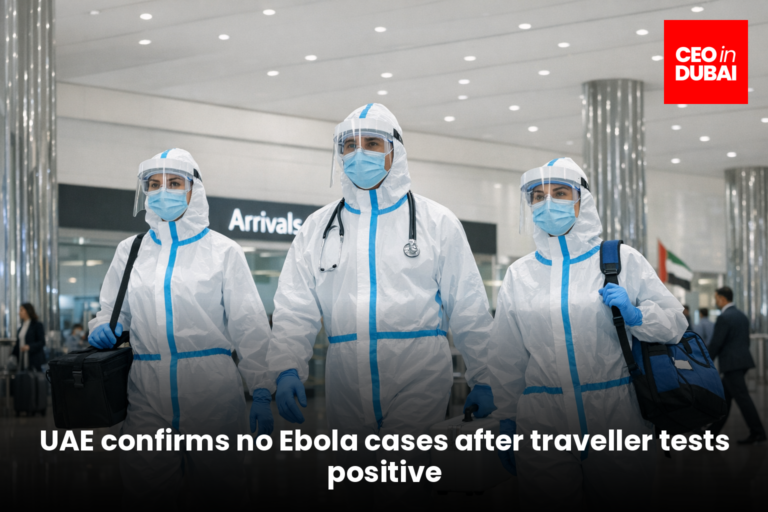
The UAE Ministry of Health and Prevention has confirmed that no Ebola cases have been detected in the country after a Congolese national who had visited the Emirates later tested positive for the virus on arrival in Uganda.
The ministry’s message is direct: the UAE has not recorded a case linked to the traveller, the individual did not visit any healthcare facility during their stay, and precautionary public health measures have been activated in line with national and international standards.
What MoHAP has confirmed
MoHAP said no Ebola cases have been detected within the UAE. The statement follows reports of a traveller who passed through the country before being diagnosed after arriving in Uganda. The person has been identified in the available reports as a Congolese national.
The ministry also confirmed a key detail for public health teams: the individual did not visit any healthcare facilities while in the UAE. That matters because healthcare settings are among the places where authorities would immediately focus if a potentially infectious traveller had sought medical care during a stay.
Authorities have not released the traveller’s full itinerary in the UAE. They have also not provided details on any people who may have had contact with the traveller during that period. For now, the official position remains that no case has been identified in the country.
MoHAP’s central message is simple: no Ebola cases have been detected in the UAE.
How authorities are handling the alert
The UAE has activated precautionary public health measures, including risk assessments and contact tracing. MoHAP said these steps are being carried out in line with national and international health standards, a sign that officials are treating the case as a cross-border health alert rather than a domestic outbreak.
Risk assessment is the first practical layer. Health teams review what is known, what remains unclear, and where exposure may or may not have occurred. In this case, the known facts include the traveller’s visit to the UAE, the later positive test in Uganda, and the absence of any recorded visit to a UAE healthcare facility.
Contact tracing is the second layer. The ministry has not disclosed who may have been contacted or assessed, and it has not published details about possible exposure locations. That restraint is not unusual in sensitive health investigations, where officials often balance public reassurance, privacy, and the need to avoid speculation.
The UAE is also coordinating with the World Health Organization and international health authorities to monitor developments and assess potential risks. That international link is central because the diagnosis happened after the traveller left the UAE and arrived in Uganda, meaning information has to move across borders as quickly and accurately as possible.
What remains unknown
The biggest unanswered question is the traveller’s precise movement inside the UAE. Officials have not released details about where the individual stayed, how long they remained in the country, or whether they had close contact with anyone during the visit. The research available does not provide those specifics.
There is also no public detail on potential contacts. MoHAP has confirmed that contact tracing and risk assessments are under way, but it has not said how many people, if any, have been assessed as part of that process. Without that information, the public picture is deliberately narrow: one traveller visited the UAE, later tested positive in Uganda, and no UAE cases have been detected.
That distinction is important. A confirmed case after departure is not the same as a detected case inside the UAE. The ministry’s update draws that line clearly, while still signalling that health authorities are taking precautionary action rather than waiting for the situation to develop.
It is also worth noting what the ministry has not said. It has not announced a local case. It has not said the traveller attended a UAE hospital or clinic. It has not released a public list of locations linked to the traveller’s stay. The official information is limited, but the core reassurance is explicit.
The message for residents and travellers
MoHAP has urged the public to rely on official sources for information and to avoid spreading unverified reports or rumours. That advisory is part of the health response, not a side note. In a situation involving a serious virus and incomplete travel details, inaccurate claims can move faster than verified updates.
For residents, the practical takeaway is to follow official health communications rather than social media speculation. The ministry has said no Ebola cases have been detected in the UAE, and it has confirmed that precautionary measures are already in place. Any change in the assessment would be expected to come through official channels.
For travellers, the same principle applies. The case became public because a traveller who had visited the UAE later tested positive in Uganda. That does not mean the UAE has detected Ebola within its borders. It does mean health authorities are monitoring the situation, working with international partners, and assessing any potential risk connected to the person’s movements.
The advisory against rumours also reflects a broader challenge in public health communication. When details such as itinerary and possible contacts are not disclosed, gaps can invite speculation. MoHAP’s instruction is designed to keep attention on verified facts: no detected cases in the UAE, no healthcare visits by the individual during their stay, and active precautionary checks.
What happens next
The next phase will depend on what risk assessments and contact tracing show. If authorities identify any relevant exposure, they can act through established health channels. If no exposure is found, the official position that the public health situation remains stable will carry more weight as monitoring continues.
Coordination with the World Health Organization and international health authorities will remain central. Because the positive test was recorded after the traveller arrived in Uganda, the UAE’s assessment relies partly on timely information-sharing between jurisdictions. That is the point of the current coordination: to close gaps, compare timelines, and manage any potential risk before it becomes a wider concern.
For now, MoHAP’s confirmation gives the UAE a clear baseline. There are no detected Ebola cases in the country, the traveller did not visit any UAE healthcare facility, and precautionary measures are active. The unknowns have not disappeared, but they are being handled inside a formal public health process.
The coming days will show whether contact tracing adds new detail or reinforces the current assessment. Until then, the signal from UAE health authorities is steady: monitor closely, communicate through official channels, and keep public attention fixed on verified information.