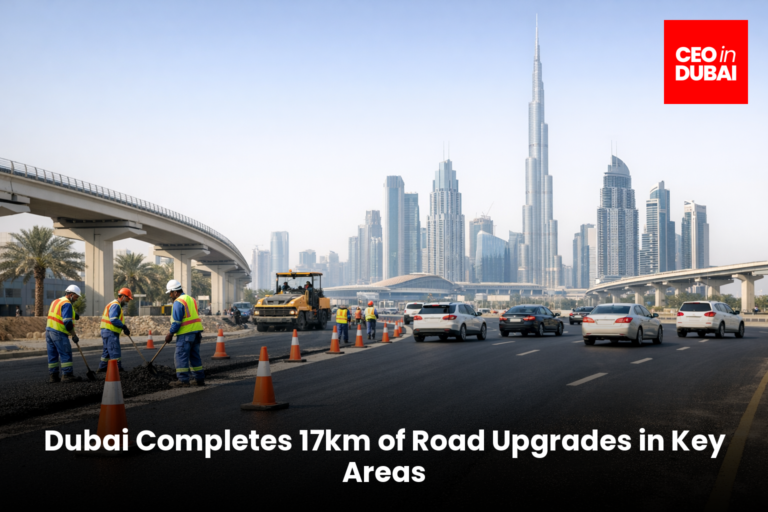
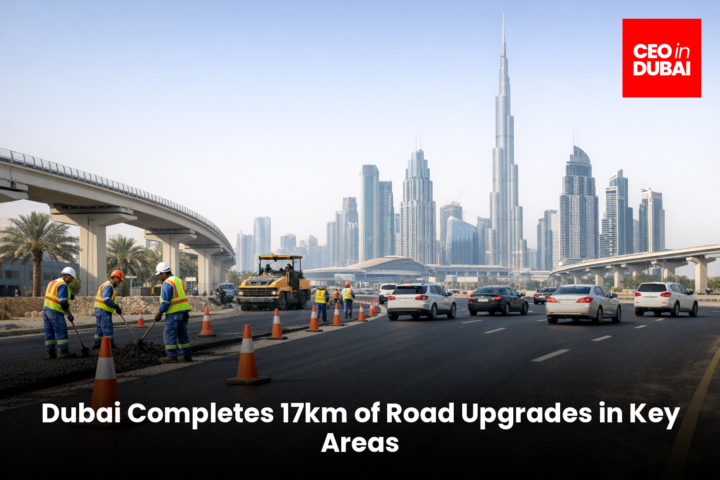
Dubai’s Roads and Transport Authority has completed 17 kilometres of asphalt road upgrades across major routes and key districts, closing a preventive maintenance push that touched highways, arterial roads, internal streets and parts of the city’s cycling infrastructure.
The works, completed in early June 2026, covered nine major streets and six districts under the RTA’s annual preventive road maintenance programme. For a city built on movement, the project is less about patching asphalt after the fact and more about keeping the network fit before cracks, potholes and surface deterioration become a costlier problem for drivers, residents and businesses.
Where the roadworks were completed
The upgraded network stretched across some of Dubai’s most recognisable corridors. The RTA identified Sheikh Mohammed bin Zayed Road, Al Khawaneej Road, Sheikh Zayed bin Hamdan Al Nahyan Road, Baghdad Road, Manama Road, Algeria Road, King Salman bin Abdulaziz Al Saud Street, Riyadh Street, Amman Street, Al Wuheida Street and Zabeel Palace Street among the streets included in the works.
The district coverage also shows how broad the maintenance programme was. The works reached Mirdif, Zabeel First, Margham, Jebel Ali Industrial 2, Al Thanyah Fifth and Al Garhoud, spanning residential, commercial and industrial areas rather than focusing only on flagship highway corridors.
That spread matters. A road network does not perform only on its biggest roads. Internal streets, access routes, industrial links and cycling sections all feed into the daily rhythm of the city. When maintenance reaches these layers together, the effect is felt by commuters, logistics operators, residents and cyclists moving through different parts of Dubai.
What the maintenance programme included
The project covered maintenance and rehabilitation works on asphalt roads. According to the RTA’s stated scope, the programme included highways, arterial roads, freeways and internal roads in residential, commercial and industrial areas. It also included sections of Dubai’s cycling infrastructure.
This is the practical side of infrastructure management: keeping road surfaces stable, safe and ready for heavy use before defects become disruptive. The brief identifies cracks, surface deterioration and potholes as the types of issues the RTA’s survey process was designed to detect. Addressing those issues early helps protect road performance and user safety.
The inclusion of cycling infrastructure is notable because it places micromobility within the same maintenance discipline as roads used by cars, buses and freight vehicles. Dubai’s movement system is increasingly multi-layered, and surface quality matters across all of it. A pothole on a main road is a hazard; a poor surface on a cycling section can be just as disruptive for a different kind of road user.
The annual nature of the programme also gives the works a clear operating logic. This was not framed as emergency repair. It was preventive maintenance, planned as part of a recurring cycle aimed at extending the life and reliability of the road network.
AI and laser surveys behind the repairs
The RTA used advanced laser technologies and artificial intelligence to carry out comprehensive road network surveys. The technology helped identify road condition issues including cracks, surface deterioration and potholes, allowing the authority to address them proactively.
That shift from reactive repair to data-led maintenance is central to Dubai’s broader smart city direction. Instead of waiting for defects to be reported or for road quality to decline visibly, the RTA can use survey tools to map issues across the network and prioritise intervention before they affect performance or safety.
For Dubai’s infrastructure operators, this is where technology becomes a business tool rather than a showcase item. Roads are economic assets. They carry employees, customers, deliveries, airport traffic, industrial movement and daily neighbourhood trips. When surface quality is monitored systematically, the city can manage that asset with tighter control and fewer avoidable disruptions.
The founder angle here is civic rather than private: the RTA is building the systems that let Dubai scale. Its use of artificial intelligence and laser survey technology reflects a governing model based on proactive asset management. That matters in a city where transport reliability is tied directly to business confidence, real estate demand and everyday quality of life.
How traffic was managed during works
Maintenance on active roads can create its own pressure if diversions are poorly handled. The RTA said traffic diversions during the works were designed after detailed engineering studies and in line with international best practices, with the aim of minimising disruption and maintaining smooth traffic movement.
Motorists were advised to follow road signage and exercise caution while passing through temporary diversion routes. That instruction may sound routine, but it is part of the operating discipline needed when major routes and district roads are being worked on across a broad network.
The careful design of diversions is especially important in a city where road use is not limited to peak-hour commuting. Dubai’s road network serves residential communities, commercial districts, industrial zones and long-distance routes across the emirate. Temporary traffic changes therefore affect a wide range of users, from residents in Mirdif and Al Garhoud to businesses linked to Jebel Ali Industrial 2.
By tying traffic management to engineering studies and established best practice, the project treated mobility during construction as part of the maintenance work itself. In a dense, fast-moving urban network, preserving traffic flow while upgrading the road surface is not a secondary task. It is part of the delivery.
Why it matters for Dubai’s next phase
Road maintenance rarely carries the drama of a new bridge or a major interchange, but it is one of the clearest signals of whether a city is managing growth well. Dubai’s latest 17-kilometre programme points to a transport strategy focused on keeping existing assets reliable while the emirate continues to expand its movement needs.
For businesses, dependable roads support predictable journeys, efficient transport links and smoother access across residential, commercial and industrial areas. For residents, the benefits are more immediate: better road surfaces, safer movement and fewer performance issues caused by deterioration that has been allowed to linger.
The project also reinforces Dubai’s position in smart city infrastructure through a practical application of artificial intelligence and laser technology. The value is not in the technology alone. It is in how the data is used to find defects early, plan maintenance and reduce the chance that road users experience avoidable safety or performance problems.
With the early June 2026 works now complete, the focus shifts to how the RTA continues applying preventive maintenance across the network. Dubai’s roads will keep carrying the city’s growth; the next test is how early, how precisely and how quietly the emirate can keep them in shape.