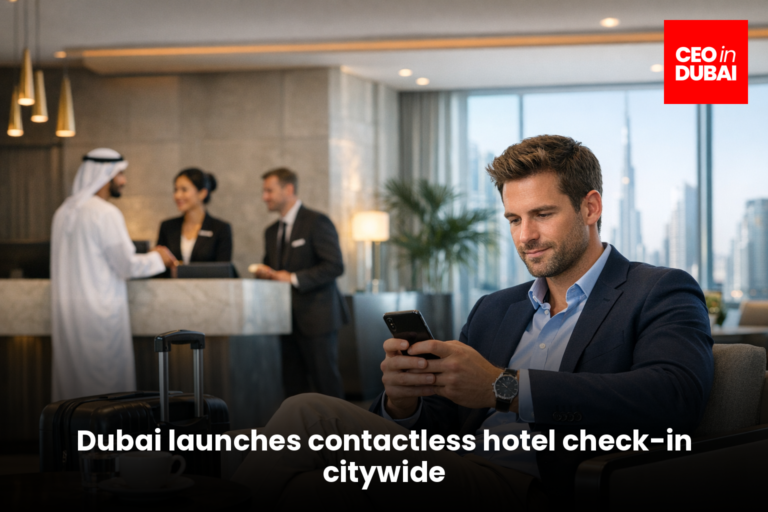
Dubai has launched a citywide one-time contactless hotel check-in system that lets guests complete registration before they arrive and bypass front desk procedures across future stays.
Announced on December 9, 2025, the Dubai Department of Economy and Tourism-led initiative sits under the direction of His Highness Sheikh Hamdan bin Mohammed bin Rashid Al Maktoum, Crown Prince of Dubai, Deputy Prime Minister, Minister of Defence of the UAE, and Chairman of The Executive Council of Dubai. It gives hotels and holiday homes a ready route to faster arrivals at a moment when Dubai’s visitor numbers are still climbing.
How the one-time check-in system works
The system moves hotel registration from the front desk to the guest’s mobile device. Before arrival, visitors upload identification documents and biometric data. Once that process is complete, the information remains valid until the ID expires.
That one-time step is the core change. Guests do not need to repeat the full registration process for every stay while their ID remains valid. For future bookings, verification can happen through quick facial recognition, allowing arrivals to move past the usual front desk checks.
For travellers, the immediate benefit is practical: less time in a queue after a flight, fewer repeated document checks, and a smoother first interaction with the property. For hotels, it shifts a heavily manual process into a digital flow that can start before the guest reaches the lobby.
The rollout also brings holiday homes into the same conversation as hotels. That matters in a city where the accommodation mix spans major luxury properties, business hotels, serviced stays and licensed short-term rentals. A citywide system only works if it can serve that breadth.
Built for hotels and holiday homes without major infrastructure changes
Dubai has made the platform available for immediate integration across the hospitality sector, including hotels and holiday homes, without major infrastructure changes. That detail is important for operators. Digital upgrades often stall when they demand new hardware, disruptive installation or long implementation cycles.
Here, the city is positioning the system as an integration layer rather than a property-by-property rebuild. Hotels can connect through authorised providers, with Hudini, a smart hospitality solutions company, among the first fully certified technology providers facilitating the new digital check-in process.
The business angle is clear. Hospitality technology companies now have a defined role in Dubai’s official guest arrival infrastructure. For providers such as Hudini, certification places them inside a market-wide shift rather than a single hotel pilot. For hotel owners and operators, the value lies in being able to adopt a city-backed process through providers already cleared to support it.
The full list of authorised technology providers beyond Hudini has not been specified in the available sources. That leaves room for more providers to enter the field as properties assess how to connect existing booking, guest management and arrival systems to the new process.
Why the timing matters for Dubai tourism
Dubai is rolling this out into a market with strong visitor momentum. The emirate hosted 15.70 million international overnight visitors between January and October 2025, a 5% year-on-year increase.
Dubai hosted 15.70 million international overnight visitors between January and October 2025, up 5% year on year.
That scale turns small friction points into citywide operational issues. Every repeated ID check, every arrival queue and every manual front desk bottleneck is multiplied across millions of stays. A more efficient check-in process is not just a guest convenience; it is part of how a high-volume destination manages growth.
The system also reflects how Dubai competes. The city has built much of its tourism appeal around ease of movement, service standards and a sense that visitor processes should be simple. Contactless hotel check-in fits that positioning because it targets one of the first moments in a trip: the transition from arrival to room.
It also speaks to business travellers, repeat visitors and residents booking staycations. The one-time model has particular value for guests who return regularly, because they should not need to re-enter the same information for each qualifying stay while their identification remains valid.
Public-private collaboration behind the rollout
The initiative is led by the Dubai Department of Economy and Tourism and supported by multiple authorised technology providers. That structure matters because hotel check-in touches both public requirements and private guest experience. It involves identity verification, property operations, technology integration and customer service.
Helal Saeed Almarri, Director General of DET, described the technology as a “pivotal moment” for the hospitality sector and highlighted the power of collaboration between public and private entities. The comment captures the operating model behind the rollout: government sets the framework, certified providers build the rails, and hospitality businesses implement the service.
Sheikh Hamdan stated that the rollout aligns with the Dubai Economic Agenda, D33, and its objective of strengthening the emirate’s position as a global hub offering seamless urban experiences. In that context, hotel check-in is one part of a broader agenda: make the city easier to use, not only easier to visit.
There are still details the available sources do not provide. Specific information about biometric data storage and security measures has not been set out in the research available. For hotels, guests and technology partners, those details will be closely watched as adoption widens across the sector.
What comes next for Dubai’s seamless visitor journey
The longer-term ambition goes beyond hotel lobbies. The platform may extend to other services, including car rentals, allowing one authentication process to streamline multiple touchpoints during a visitor’s stay.
That is where the system could become more than a hospitality upgrade. If one verified identity can support several parts of a trip, Dubai can reduce repetition across the visitor journey: arrival, accommodation and potentially onward mobility. The brief does not confirm a rollout timetable for those additional services, but it signals the direction of travel.
For operators, the next phase will be about adoption. Hotels and holiday homes will need to decide how quickly to integrate, how to communicate the process to guests, and how to keep the human service layer strong when the paperwork moves off the desk.
For Dubai, the launch is another test of execution at city scale. If the system is adopted widely, the next hotel arrival in the emirate may start long before the guest walks through the lobby doors.